The Antidote to Shame: Avatar: The Last Airbender and the Parable of the Wedding Feast
Note: The following essay is the second in a series of essays that aim to examine the life of Christ through the lens of popular art, media, and storytelling. For more content like this, check out Unreliable Narrators wherever you listen to podcasts.
“For everyone who exalts himself will be humbled, and he who humbles himself will be exalted.” Luke 14:11
The modern age is obsessed with breaking stories down to their chemical elements. With the help of websites like TV Tropes, we identify which storytelling ingredients we like and don’t like, just as we choose what to eat for dinner. Different audiences have always gravitated toward certain themes and genres—perhaps you love science fiction or murder mysteries—but we can now afford to be choosy on the granular level. Spend enough time poking around social media and you are sure to encounter a list of the best enemies-to-lovers novels, or the top ten shows featuring an antihero.
Although it has taken on modern trappings, the project of analyzing stories on a mechanical level goes all the way back to Aristotle, who wrote the world’s first TV Tropes article in his philosophical work titled Poetics. Over 2,300 years later, we are still following in Aristotle’s footsteps, taking stories apart like watches to discover what makes them tick—and after centuries of studying the art of storytelling, we have learned at least one thing: people really, really love a good redemption arc.
Nothing beats a well-executed redemption arc. In fact, redemption arcs are so common in popular media that you can’t spin a wheel of Netflix originals and throw a dart without hitting one. There is, however, one redemption arc that no self-respecting top ten list would ever leave out: the story of Prince Zuko from Avatar: The Last Airbender. There’s a simple reason for that.
It's the best one.
The Prince in Exile
Originally released by Nickelodeon between 2005 and 2008, Avatar: The Last Airbender is an animated television series set in an Asian-inspired fantasy world where humans live in four nations, each named after one of four natural elements: the Water Tribes, the Earth Kingdom, the Fire Nation, and the Air Nomads. Only certain individuals possess the power of “bending,” or the magic ability to manipulate one of these four elements—but the Avatar, the only living person with the power to bend all four elements, is burdened with the responsibility of maintaining balance in the world. Avatar: The Last Airbender follows the story of the present-day Avatar, a young monk named Aang, as he undergoes a journey to master all four elements and defeat Fire Lord Ozai, supreme leader of the Fire Nation, whose tyrannical rule oppresses the other three nations.
While Fire Lord Ozai rules from his palace within the Fire Nation, Aang faces a more immediate threat: Zuko, the exiled Fire Nation prince who pursues the Avatar relentlessly. While he is unquestionably a villain, Zuko has deeply sympathetic motivations. Years ago, Zuko stood up for a battalion of Fire Nation soldiers whom his father was sending to certain death. For this offense, his father challenged him to a firebending duel. Zuko refused to fight his own father, and in return, the Fire Lord burnt the left side of his son’s face beyond recognition, leaving a horrible scar, and then exiled him. In order to restore his honor and return home, Zuko must capture the Avatar.
For such a young man, Prince Zuko has suffered a great deal. His mother disappeared when he was a small child; his sister tormented and manipulated him; his father disfigured him and sent him into the world with nothing but his aging uncle, a leaky old ship, and a hopeless mission. That suffering has infused him with anger and pride. Zuko is obsessed with his own reputation, status, appearance, and inheritance, all of which he sums up in the word “honor.” This is his favorite word, and he uses it in every other sentence. In the very first episode, Zuko’s Uncle Iroh reminds him that his “father, grandfather, and great-grandfather all tried and failed” to find and capture the Avatar.
“Because their honor didn’t hinge on the Avatar’s capture,” Zuko counters. “Mine does.”
Zuko’s motivations are both realistic and relatable. He wants to be respected. He wants to be a hero to his country and a son to his father. He wants the inheritance that, as a prince, he is rightfully owed: a throne and a kingdom. Instead, he suffers in exile. Can we really blame him for hunting the Avatar with such burning intensity?
The Parable of the Wedding Feast
On a certain Sabbath day two thousand years ago, the Son of Man arrived to have dinner at the house of a ruler of the Pharisees. According to Luke, Jesus was surrounded by lawyers and Pharisees who were “watching him carefully,” perhaps because there was a man present who had dropsy—a horrible disease that disfigures its victim’s face, just as Zuko’s face was disfigured by his father. The lawyers and Pharisees waited to see what Jesus would do. Would he break the law by working on the Sabbath?
But Jesus, knowing what they were waiting for, asked the Pharisees, “Is it lawful to heal on the Sabbath, or not?” When the lawyers and Pharisees were not willing to answer this question, Jesus took the man, healed him, and sent him off before asking a follow-up question: “Which of you, having a son or an ox that has fallen into a well on a Sabbath day, will not immediately pull him out?” One commentator suggests that by appealing to the basic decency of the lawyers and Pharisees, Jesus was calling out the best of the image of God within them. You wouldn’t leave a child in a well, would you? You wouldn’t even let an animal suffer needlessly, so how much more should you do good to the sick among you? Once again, the lawyers and Pharisees had no answer.
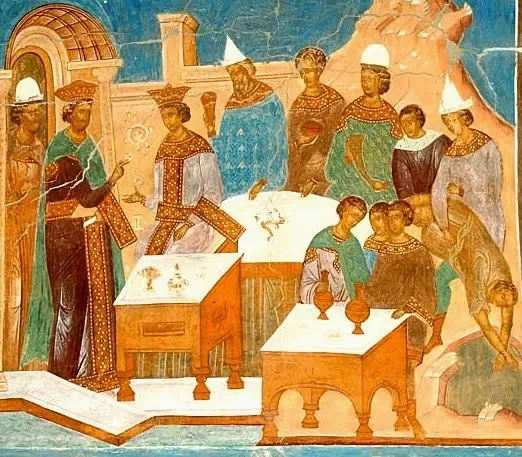
It was in the aftermath of this moment, in the context of his compassion for a disfigured man, that Christ noticed how his fellow dinner guests sought the place of honor. At the time, dinner guests would have reclined on couches positioned in the shape of an upside-down U. The noblest, most distinguished guest would recline in the highest place—that is, the center spot on the uppermost couch—while the other guests would take the spots around him, according to their social status. But just like another scarred outcast that we know and love, the guests at this particular Sabbath dinner jostled one another for the place of honor that each one felt was his due. In response, Christ offered the guests some advice.
“When you are invited by someone to a wedding feast,” he said, “do not sit down in a place of honor, lest someone more distinguished than you be invited by him, and he who invited you both will come and say to you, ‘Give your place to this person,’ and then you will begin with shame to take the lowest place. But when you are invited, go and sit in the lowest place, so that when your host comes he may say to you, ‘Friend, move up higher.’ Then you will be honored in the presence of all who sit at table with you. For everyone who exalts himself will be humbled, and he who humbles himself will be exalted.”
Taking the Lowest Place
When Zuko’s early efforts to capture the Avatar fail, his father orders that Zuko come home as a prisoner. Now on the run in the Earth Kingdom, Zuko and his uncle Iroh find themselves in exile a second time, fugitives from the wrath of the Fire Nation. Zuko is suddenly poor, homeless, starving, and forced to accept the kindness of peasants who do not know that he, a tattered beggar, is secretly the son of their oppressor. With shame, the prince begins to take the lowest place.
As they travel in poverty like peasants, Uncle Iroh advises Zuko that if he is to find peace, he must first let go of his shame. Frustrated, Zuko bursts out, “But I don’t feel any shame at all! I’m as proud as ever.”
“Prince Zuko,” Iroh replies, “pride is not the opposite of shame, but its source. True humility is the only antidote to shame.”
“Well,” Zuko says bitterly, “my life has been nothing but humbling lately.”
In another pivotal scene, Iroh teaches Zuko how to perform an ancient trick: redirecting lightning. Because certain Firebenders (like Zuko’s father) can attack with lightning, Iroh is secretly preparing Zuko for the day when he will face his father again. But Zuko is an impatient student. He struggles to redirect lightning because he is not at peace; he cannot allow the lightning to flow through him. Despite this, Zuko is eager to practice, and he demands that Iroh shoot lightning at him. Naturally, Iroh refuses, knowing that his nephew would be hurt or killed. Angry and confused, Zuko leaves his uncle and flees to a nearby mountaintop where a thunderstorm has gathered.
“You've always thrown everything you could at me,” Zuko shouts at the thunderclouds—even, perhaps, at God. “Well, I can take it! And now I can give it back!”
But the lightning does not strike.
“Come on! Strike me!” the prince screams. “You've never held back before!”
Furious at the silence of the storm, Zuko falls to his knees. Tears stream down his face. He does not realize that the storm is not acting in judgment, but mercy: mercy not to strike Zuko with lightning when he is not yet ready to redirect it. The irony, of course, is that Zuko is the son of the Fire Lord. He is complicit in the oppression of millions. He deserves, perhaps, the wrath of God—on the mountaintop, he even unwittingly begs for it—but in mercy, God stays his hand.
This moment on the mountaintop is a microcosm for Zuko’s entire journey. True judgment would mean allowing Zuko to fight on behalf of the oppressive Fire Nation, to become the next Fire Lord without any change of heart, to remain steadfast in his wrongheaded worldview. To be saved, Zuko must change, even though that change is excruciatingly painful. Zuko’s suffering looks like judgment, but turns out to be mercy in the end.
Slowly, this suffering changes Zuko. Through his humiliation, he begins to see the world anew. As a fugitive, he gains new perspective through his encounters with the people his father has forced into subjugation. When he sees his own nation from afar, he does so from the vantage point of the conquered. At last, Zuko begins to understand that in order to be saved, he must give up everything he has ever known, take up his proverbial cross, and follow the Avatar. Of course, this understanding does not come easily. Along the way, Zuko even betrays his uncle, the person who has always loved him most. But when Zuko is finally ready, he confronts his father, renounces the Fire Nation, and sets out as a self-made exile to offer his services to the Avatar.
But Zuko’s troubles do not end there. He finds that convincing the Avatar and his friends of his change of heart is not easy, and given the prince’s track record, it is difficult to blame them. When Zuko tries to explain himself, they reject him. The usually trusting Aang insists that nothing will ever convince him to trust Zuko, and the prince’s subsequent pleas are met only with promises of retaliation if he ever comes near them again. In response, Zuko kneels before them, bowing his head to expose his neck and extending his arms, wrists pressed together, as if anticipating being bound.
“If you won’t accept me as a friend,” he says, “then maybe you’ll take me as a prisoner.”
His choice to kneel at this pivotal moment demonstrates how far he has come. The old Zuko would not bend; he refused to bow to anyone. He is willing to humble himself to the point of physical vulnerability before the very people he once hunted. He exposes himself to subjugation at best, death at worst, at the hands of the Avatar. Zuko is a prince, and he offers himself as a prisoner.
Friend, Move Up Higher
Though his inheritance was the throne, Zuko humbles himself and takes the lowest place instead. But when Zuko gives up his place of honor, he finds new hope fighting alongside the Avatar. Striving for his own glory, he was only humbled—but now that he has been humbled, he is almost unrecognizable to all who once knew him as the angry Fire Prince.
This complete transformation culminates in a final battle between the forces of good and evil. In this conflict, Zuko finally faces and defeats his cruel sister. He watches the Avatar conquer his father. He comes into his own as a leader and warrior. And in the wake of victory, Zuko himself is crowned the new Fire Lord. At Zuko’s coronation, he kneels again—this time not to offer himself as a prisoner, but to accept the crown. The newly crowned Fire Lord receives his place of honor at last, for he who exalts himself will be humbled, and he who humbles himself will be exalted.
But while he was suffering, Zuko could not have foreseen the triumph that awaited him at the end of his journey. The experience of the transformation is not glorious, but harsh and painful. His mother’s loss, his sister’s hatred, his father’s rejection, his exile, the scar on his face—all of it feels not like mercy, but like judgment from above. It is not until the end that Zuko recognizes his suffering for what it always was: redemption.
While Zuko suffers in the depths of hell, he cannot see the heaven that awaits him at the end of his journey. So it is for all of us who mourn, who pray, who wait in agony upon the Lord—and so it surely was for the man with dropsy whom Christ healed on that Sabbath day so long ago. Like Zuko, that man must have spent his whole life wondering why God had cursed him above all others. Perhaps he, like Zuko, endured the rage of injustice, wrestled with the loneliness of despair, and cried out to God in the thunderstorm. But in the end, perhaps the man with dropsy suffered years of shame because without it, he could not have experienced this one glorious moment: the moment when his scarred face was caressed by the very hand of God.
