Book Review: Sunrise on the Reaping, by Suzanne Collins
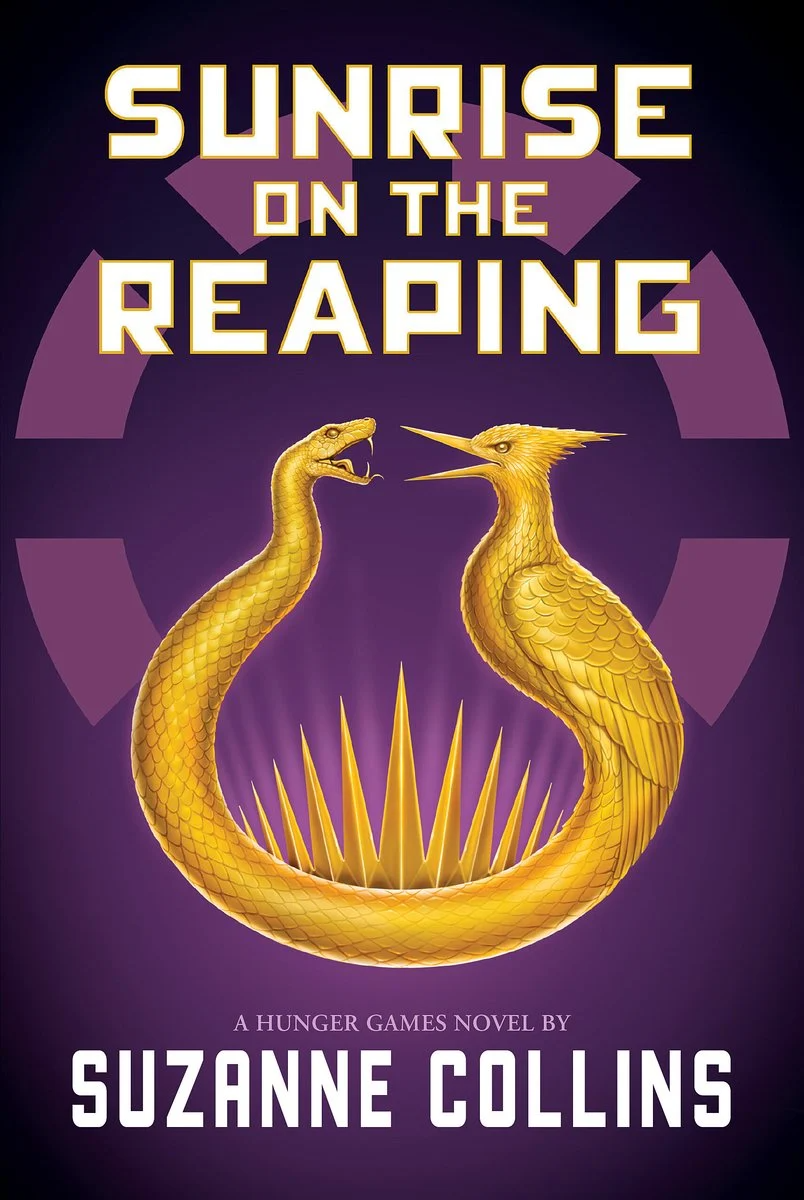
All book reviews are on a five-star scale. The following review contains major spoilers for Sunrise on the Reaping, by Suzanne Collins.
Like many teenagers in the 2010s, I grew up on the Hunger Games trilogy. I have always admired the work of Suzanne Collins, especially because classical influences shine through her books in such a thoughtful way. On top of all that, Haymitch Abernathy has always been my favorite Hunger Games character, so when I heard that Collins was publishing a prequel that told the story of Haymitch’s Games, I was excited to go back to my roots and read a new Hunger Games book for the first time in over a decade.
In Sunrise on the Reaping, a sixteen-year-old Haymitch Abernathy is reaped for the Hunger Games as punishment for protecting his girlfriend, Lenore Dove, from the Peacekeepers. Upon his arrival in the Capitol, he agrees to participate in a secret plot to break the arena from the inside. But when Haymitch’s plan to destroy the arena fails, the Capitol retaliates by killing everyone he loves.
I’ve already discussed this book a bit in my post about choices and consequences, so I’ll do my best to break new ground here. Disclaimer: I have not read The Ballad of Songbirds and Snakes, so the Lucy Gray references in this book went over my head.
From the beginning of the book, it’s clear that Collins is drawing an intentional parallel between Haymitch and Katniss, the protagonist of the original trilogy. Like Katniss, Haymitch lost his father in a coal mining accident. Like Katniss, Haymitch cares for his mother and younger sibling. Like Katniss, Haymitch is reaped in an unusual way as a result of his actions (even though he doesn’t actually volunteer).
The parallels continue when Haymitch arrives at the Capitol. At the opening parade, one of Haymitch’s fellow tributes, Louella, is killed in a chariot accident. Haymitch makes a big show out of laying his dead friend at President Snow’s feet, suggesting that Snow is responsible for her death. (He really isn’t, funnily enough. The chariot crash was genuinely an accident. Snow is responsible for a lot of things, but Louella’s death arguably is not one of them.)
The parade incident is Haymitch’s version of Katniss shooting an arrow at the Gamemakers. Soon he gets a personal audience with President Snow, who tells him that if he displays any rebellious behavior again (especially in public), the Capitol will kill his loved ones.
Based on everything I’ve said so far, you might think that Haymitch is just another rebel in the long tradition of YA rebels (popularized, in part, by Katniss herself). But that’s the odd part—he isn’t. On the first page of Chapter One, Haymitch tells us:
I’m hoping to finish my work before the ceremony so I can devote the afternoon to the two things I love best—wasting time and being with my girl, Lenore Dove.
These don’t sound like the words of someone harboring a secret desire to overthrow the Capitol. In fact, Haymitch seems perplexed at Lenore Dove’s suggestion that the Hunger Games could ever end. Defiance of the Capitol is pretty clearly the last thing on his mind.
Realistically, that’s probably the mindset of most people in Panem who grew up with the Hunger Games. The Reaping is just a fact of life. It’s horrible, of course, for the unlucky families whose children are sent to die in the Games—but statistically, it’s a low percentage of the population. After all, that’s what the Reaping is supposed to do: assert control over the districts, but don’t push them far enough to cause an uprising.
So complacency is understandable, even sympathetic. Rebellion against oppression might be admirable, but what about all the normal people who suffer quietly under the regime? Who just want to care for their families without exposing them to retaliation from the Capitol?
This book had a lot of potential to showcase that perspective. After all, we already know from the first trilogy that the Capitol ruined Haymitch’s life and killed everyone he loved. Wouldn’t it be interesting to find out that Haymitch was just an ordinary kid who did everything he possibly could to play by the Capitol’s rules, and yet they still ruined his life? What if Haymitch’s desire to rebel against the Capitol rose out of a realization that you can’t win the Games even after you’ve won? That kind of story would give us fresh insight on the ways in which the Capitol crushes even the most compliant people.
Aside from the clunky storytelling, Haymitch’s sudden defiant streak that appears the moment he arrives in the Capitol also poses a serious problem for one of the book’s primary metaphors. One of the four epigraphs that opens the novel is a quote from skeptic philosopher David Hume:
That the sun will not rise tomorrow is no less intelligible a proposition, and implies no more contradiction, than the affirmation, that it will rise.
This is probably the best-known argument in Hume’s epistemology. We assign effects to causes, Hume argues, only through observation. Because we have no other way of determining cause and effect, we can never really prove that one thing causes another. When someone pushes a glass bottle, we believe the bottle will fall only because that is what has always happened. But the mere fact of observed repetition is not evidence that the bottle will fall the next time someone pushes it, at least according to Hume. Similarly, we cannot know for certain that the sun will rise tomorrow. We only expect it to rise because it has always done so, but that expectation is not the same thing as proof.
Collins uses Hume’s famous sunrise analogy to make a point about complacency in the face of tyrannical regimes. The people of Panem accept the Reaping as inevitable because it happens every year at the same time, but the fact that it has always happened does not mean that it must always happen. There is a world in which the sun does not rise on the Reaping.
On its own, this thoughtful blend of philosophy into fiction is a perfect example of what I love about Suzanne Collins. The trouble is that Collins also resists giving Haymitch a real character arc, which mitigates the effectiveness of the sunrise metaphor.
Here’s what I mean. Initially, we’re told that Haymitch doesn’t really care about ideals or revolution or freedom or anything besides wasting time and hanging out with his girlfriend. In the first chapter, Lenore Dove is the one who first insists that the reaping is not inevitable:
“It’s going to be all right,” I say, which rings hollow.
“You don’t really believe that, do you?”
“Maybe not. But I try to. Because the reaping’s going to happen no matter what I believe. Sure as the sun will rise tomorrow.”
Lenore Dove frowns. “Well, there’s no proof that will happen. You can’t count on things happening tomorrow just because they happened in the past. That’s faulty logic.”
“Is it?” I say. “Because it’s kind of how people plan out their lives.”
“And that’s part of our trouble. Thinking things are inevitable. Not believing change is possible.”
“I guess. But I can’t really imagine the sun not rising tomorrow.”
In theory, this exchange sets the stage for the character arc that I described earlier: one in which the Capitol destroys Haymitch despite his every effort to comply with their demands, and the devastation of that experience leads him to adopt Lenore Dove’s philosophy. But since most of the novel is about Haymitch’s plan to break the arena from the inside, it clearly doesn’t take very long for Haymitch to accept Lenore Dove’s rebellious ideals. The character arc is over before we hit the halfway point.
Which brings us to the end of the book. When Lenore Dove is killed by the Capitol and dies in Haymitch’s arms, they have this melodramatic exchange:
Her eyes fixate on something in the distance. “See that?” she says hoarsely.
I turn my head and see the sun, just peeking over the horizon. “What? The sun?”
“Don’t you…let it…rise…” she gets out.
Tears choke me. “I can’t stop it. You know I can’t stop it.”
Her head jerks a bit to the side. “…on the reaping,” she whispers.
First of all, this scene is incredibly heavy-handed. We would have understood the point without Collins dangling a big neon sign in front of us that says HEY REMEMBER THAT HUME THING, IT’S ABOUT HOW TYRANNY ISN’T INEVITABLE AND CAN BE OVERTHROWN. But more importantly, this moment can’t transform Haymitch and set the course for the rest of his life because he’s already undergone that exact transformation. He’s already demonstrated, almost from the beginning, that he is perfectly willing to fight the Capitol. Lenore Dove’s dying wish is for Haymitch to do something that he has, more or less, already signed on to do.
Despite these criticisms, I really do think there’s a lot to appreciate in Sunrise on the Reaping. Ampert (aka, Rue 2.0) is adorable and his brotherly dynamic with Haymitch is heartbreaking. The subtext in President Snow’s dialogue is deliciously malicious. The novel is sprinkled through with memorable and even haunting moments, such as when Haymitch hears one of his enemies weeping underneath the tree in which he is hiding, and moved by pity, he tosses a piece of chocolate down to her.
In my opinion, the best part of the book occurs near the end. After emerging from the arena as the unexpected victor, Haymitch watches a “supercut” of the Games only to discover that the Capitol has sanitized the footage, eliminating all traces of Haymitch’s efforts to break the arena. This twist adds a fresh angle to the novel’s thesis about how propaganda distorts the truth and buries rebellions before they can ever begin. Whoever controls the public narrative also controls the means by which revolutions catch fire. (See what I did there?)
Obviously, I have a lot of ideas about how the novel could have taken Haymitch’s story in a more original direction—but it’s not really fair to judge a book by what it isn’t. So based on the novel’s own merits, here’s the verdict: it’s fine. Thoughtful. Entertaining. But nothing special. I give Suzanne Collins’s Sunrise on the Reaping three stars.
What’s your favorite (or least favorite) Hunger Games book? What did you think about Sunrise on the Reaping? Let me know in the comments!
