Ridiculous Hope: “All I Want For Christmas is You” and the Annunciation of our Lord
Note: The following essay is the first in a series of essays that aim to examine the life of Christ through the lens of popular art, media, and storytelling. For more content like this, check out Unreliable Narrators wherever you listen to podcasts.
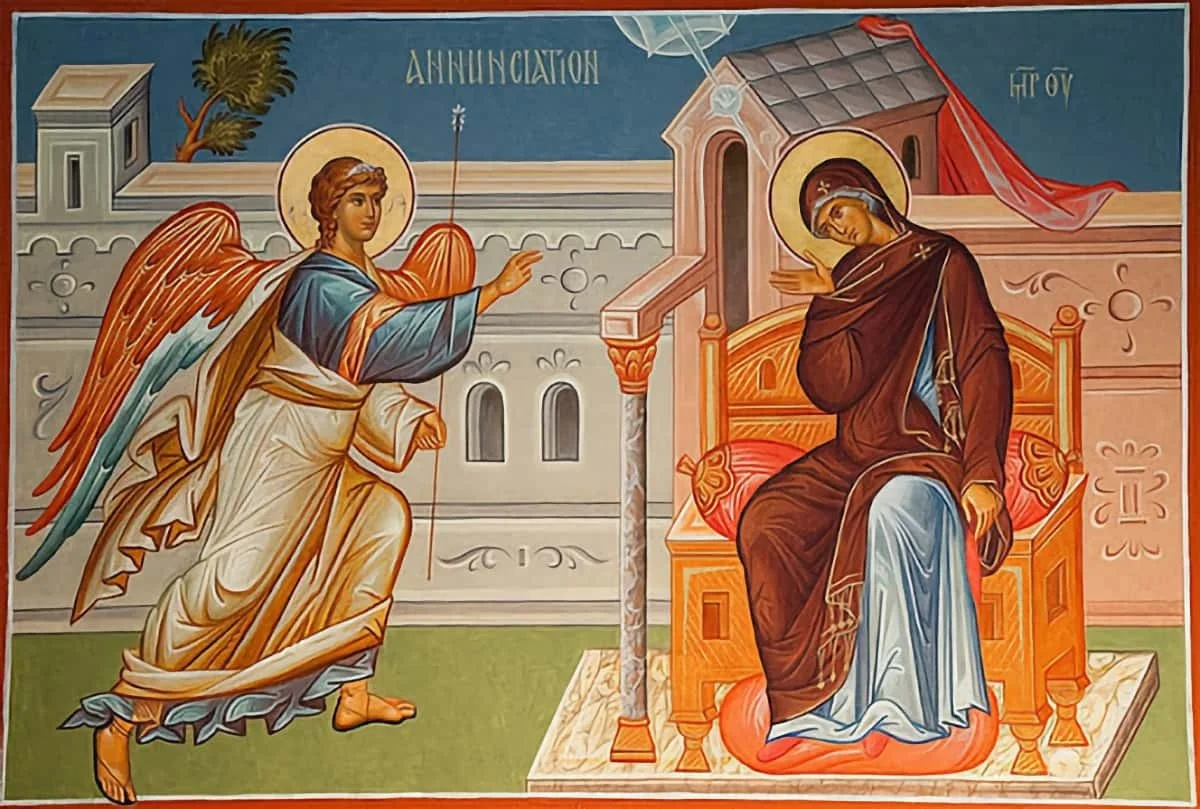
And the angel answered her, “The Holy Spirit will come upon you, and the power of the Most High will overshadow you; therefore the child to be born will be called holy—the Son of God. And behold, your relative Elizabeth in her old age has also conceived a son, and this is the sixth month with her who was called barren. For nothing will be impossible with God.”
Luke 1:35-37
It’s the summer of 1994, and pop icon Mariah Carey is at the height of her career. She’s still basking in the glow of her wildly successful album Music Box, and unbeknownst to the rest of the world, she’s already started working—reluctantly—on her next project. It’s a Christmas album, even though she doesn’t actually want to write a Christmas album. In the 1990s, Christmas albums are still for artists who are past their prime and ready to retire. But Carey’s then-husband and manager, Tommy Mottola, manages to convince her, and Carey starts writing songs with her co-producer, Walter Afanasieff. In 1993, they write “Miss You Most (At Christmas Time),” a sorrowful ballad, and “Jesus Born on This Day,” a modern carol with gospel undertones. But Carey wants to write something more upbeat—a rock ‘n roll number that could have stepped right out of the sixties.
So Carey and Afanasieff get together in the summer of 1994. Afanasieff starts playing around on his keyboard, improvising some pop-rock chords and riffing melodies with his left hand. And that’s when Carey sings it for the first time: The Line. “I don’t want a lot for Christmas…”
Initially, Afanasieff isn’t sold. “That sounds like someone doing voice scales,” he says. “Are you sure that’s what you want?”
But Carey has struck gold and she knows it. They play back and forth—playing a chord, singing a line, playing another chord, singing the next line—“like a game of ping-pong,” according to Afanasieff. And fifteen minutes later, the chords, lyrics, and melody of the song are done.
Thirty years later, this certified Christmas bop has sold over 16 million copies, making it the only Christmas single—ever—to achieve diamond status. In 2019, “All I Want for Christmas is You” held the top spot on the Billboard Hot 100 list for 38 consecutive weeks. The song has earned over $80 million in royalties. It’s the best-selling Christmas song written in the modern day.
Every October since 2018, social media users post photoshopped images of Mariah Carey inside a melting ice block, joking that the pop star is “defrosting.” On November 1st, 2023, Carey even got in on the joke, posting a video of herself breaking free from the ice and launching into the chorus of “All I Want for Christmas is You.” The video is titled “IT’S TIME!!”
And when it’s time, you always know, because the song is everywhere. From early November through New Year’s, you can hear it blasting in every store, gracing every Spotify playlist, repeating on every radio station, echoing in the ears of holiday shoppers and grocery store clerks and Salvation Army bell ringers. The song is synonymous with candy canes and mistletoe, with drifting snow and ice skating, with pumpkin pie and caroling. Love it or hate it, “All I Want for Christmas is You” is the soundtrack to the secular Christmas season.
The song begins with a melodic, light-hearted introduction played by what sounds like a music box. After a breath of anticipation, Mariah Carey sings:
I don’t want a lot for Christmas
There is just one thing I need
I don’t care about the presents
Underneath the Christmas tree
I just want you for my own,
More than you could ever know
Make my wish come true—
Baby, all I want for Christmas is you.
…and that’s pretty much it. Sure, there are a few more lyrics sprinkled through the song, but once you’ve heard these lines, you’ve basically heard everything. Melodically, the song bounces with barely contained energy. Bright keyboard chords, a rocking drumbeat, the excitement in Mariah’s vocals, and ringing sleighbells carry us dancing through the song. But for all Mariah Carey’s trills and frills, the song’s artistic vision is simple: a simple message over simple chords with a simple musical style. Despite this simplicity, even those who dread Mariah Carey’s inevitable arrival every Christmas cannot reasonably deny the genius in her achievement. One does not achieve such fame without stumbling upon something special, even accidentally.
A Happy Sad Song
Mariah Carey doesn’t “want a lot for Christmas,” meaning material goods in the form of gifts. Her Christmas wish, instead, is to receive a person: all I want for Christmas is you. But what does that mean? She may be addressing a love interest, but not necessarily. She could just as easily be longing for the return of a brother, a sister, a parent, a friend. The song doesn’t specify, and perhaps this universality is what draws us into its dreamlike world. We don’t want something for Christmas, but someone.
But Mariah Carey’s hit is not the first Christmas song that focuses on longing for a loved one. “I’ll Be Home for Christmas,” sung originally by Bing Crosby, expresses the painful desire to spend Christmas with someone you love. In this slow, beautiful jazz number, the singer imagines the Christmas they could be spending together—complete with snow and mistletoe and presents—before finally admitting the dark truth: that “I’ll be home for Christmas…if only in my dreams.” Similarly, Carpenters’ 1970 song “Merry Christmas, Darling” is written from the perspective of someone who, for unexplained reasons, cannot be with his love on Christmas. “I’ve just one wish on this Christmas Eve,” he sings. “I wish I were with you.” Neither song explains why the two central characters cannot be together. Are these songs about a difficult breakup, a long-distance relationship, or the first Christmas after a death in the family?
No one knows, and perhaps that’s the point. While Christmas can be a beautiful and joyful time, it can also be a painful and difficult time, and for exactly the same reason: Christmas is traditionally a time when family and friends gather to celebrate. We are supposed to be together on Christmas, and when a loved one is missing, it cuts us like a knife in the side. For some, this sensation can seep through and taint the joy of Christmas altogether. The day that once produced our happiest memories can become the valley of the shadow of death.
Oddly enough, “All I Want for Christmas is You” touches on these exact same themes. The singer wants to spend Christmas together with someone, be it lover or friend or family. She wants to be united with her beloved. But the song is not mourning and wistful like the others. For all its ridiculous frivolity, something mysterious lies behind Mariah Carey’s vision. What vision permits her to be joyful while the other songs weep? Is it just her naïveté—or is it something else entirely?
The God with a Body
Many, many years ago, an old man named Abram heard the voice of God for the first time at the age of 99. We may well wonder what Abram thought and how he felt upon first hearing the voice of this strange heavenly being who spoke with such authority. The ancient Hebrew scriptures tell us that the Lord “appeared” to Abram. How did he appear? What did he look like? What form did he take? Was Abram terrified—or did he feel a strange kind of peace for the first time in his life?
Perhaps both, for we are told that Abram fell on his face.
God tells him, “No longer shall your name be called Abram, but your name shall be Abraham, for I have made you the father of a multitude of nations. I will make you exceedingly fruitful, and I will make you into nations, and kings shall come from you. And I will establish my covenant between me and you and your offspring after you throughout their generations for an everlasting covenant, to be God to you and to your offspring after you.” This is how the story of God’s people begins—with a promise. I will be God to you and to your family forever. Your children will be not only the children of Abraham, but the children of God himself.
From that moment on, God appears to his people in many forms: a burning bush, a cloud, a gentle breeze, a pillar of fire. In all these forms, God hears the cries of his people as slaves in Egypt, parts the Red Sea to rescue them, and journeys with them into Canaan—but he does so as a being, a spirit, the omniscient and omnipotent God without a body. When Moses begs to see the glory of God on top of the mountain, God agrees, but on one condition. “While my glory passes by,” God tells Moses, “I will put you in a cleft of the rock, and I will cover you with my hand until I have passed by. Then I will take away my hand, and you shall see my back, but my face shall not be seen.” God intends to protect Moses with this plan: “You cannot see my face, for man shall not see me and live.” On the mountain, Moses learns that the God without a body has a face after all, but no one may see it, not even his chosen people.
On that same mountain, God gives the law to Moses, and for hundreds of years, he watches the Israelites break the law, then beg forgiveness, then break the law again. God dwells with his people while they wander for forty years, while they conquer the promised land, and while they worship the gods of the surrounding cultures. Over and over again, God sends judges to save his people when hostile neighbors attack. He gives the Israelites kings, and watches as those kings, too, break the law and worship other gods. God is still walking with his people, still keeping his promise, as they follow the wrong traditions, worship the wrong gods, and eventually fall to the Assyrians and Babylonians. At the hands of enemies, the children of God are conquered, scattered, and sent into exile.
And then God falls silent for four hundred years.
The Annunciation of the Lord
At the end of those four hundred years, in an insignificant backwater town called Nazareth, an angel appears to a young girl named Mary, who is betrothed to a man named Joseph. When the angel Gabriel greets Mary, Luke tells us that she is “greatly troubled.” Gabriel is quick to reassure her. “Do not be afraid, Mary,” he says, “for you have found favor with God. And behold, you will conceive in your womb and bear a son, and you shall call his name Jesus. He will be great and will be called the Son of the Most High.”
Understandably, Mary has some questions. The most important question is this: “How will this be, since I am a virgin?”
But Gabriel is unconcerned by this biological objection. He tells Mary that the Holy Spirit will come upon her, and she will be overshadowed by the power of the Most High. He says that she will bear a holy child, the Son of God, “for nothing will be impossible with God.”
Throughout Christian history, the church has affirmed the sacred belief that this pronouncement by Gabriel is a request, not a command. Heaven does not strong-arm Mary into bearing the Son of God. Because she is free, she is given a free choice. In that freedom, Mary gives a remarkable response.
“Behold,” she says, “I am the servant of the Lord; let it be to me according to your word.”
And just like that, the God without a body becomes the God with a body. God comes into the world as a human child. Christ grows inside Mary’s womb, the womb that miraculously holds God and becomes wider than the heavens. In the eastern tradition, Christians call the virgin Mary Theotokos: God-bearer. The woman who carried God’s body inside her own. The human being whose DNA coils in the heart of God’s cells.
But he is not yet born. His people, who have endured God’s for four hundred years, must wait for nine months more.
Waiting for the King
The church has a name for this season of waiting for the birth of Christ: advent. In the liturgical calendar, Christians wait (and in some traditions, fast) for just a few weeks, but they do so in memory of those who waited for over a thousand years to meet their Lord face to face. Advent is the season of anticipation for the arrival of a King whose coming has been foretold for longer than we can possibly imagine.
For the church, the season of advent is synonymous with hymns that express our expectation of the Lord’s birth: “Come, Thou Long Expected Jesus” and “O Come O Come Emmanuel,” just to name a couple. But in the secular world, for better or for worse, the soundtrack of advent is Mariah Carey’s instant Christmas classic, just as it has been ever since the song first graced the radio in 1994.
There is something appropriate, I think, about the unlikely pairing of this peppy tune and the holy season of advent—something real that speaks to the heart of everyone who waits for Christmas, believer and nonbeliever alike. After all, for a song written in fifteen minutes, it has managed to cast a disproportionately powerful spell over us. Why? Okay, yes, we can point to the sleigh bells and jaunty chords and crooning vocals, but even so, the song is hiding something else beneath its playful joy—something so purely Christmas that we can’t ignore it.
But maybe we’re thinking too hard. Maybe the answer to this question, like the song, is profoundly simple. Maybe Mariah’s secret is nothing more or less than this: even in the secular world, Christmas still means waiting for a person. That waiting—that season of advent—is so deeply imprinted on our cultural memory that we cannot forget it. It may be soft, like distant music. It may be buried in ice, like a defrosting Mariah Carey meme. But we cannot ignore it, any more than we can ignore the sound of Mariah Carey’s Christmas hit playing over the department store speakers for the hundredth time.
Every advent, we long for someone: a friend, a lover, a parent, a sibling. Sometimes we long for someone who is still alive, someone who will meet us on Christmas Day, whether at the door or over a grainy video call. Sometimes we long for someone who has passed on, whom we will see only in our dreams. But buried beneath these fervent dreams lies a ridiculous hope—the hope that we will encounter Someone Else at Christmas: the God with a body, the King who eats with sinners, the One who raises the dead to life again.
Hope. Our chests ache with it. We can’t escape it. For nine months, we carry it: from the Annunciation to the green of spring, from the sweat of summer to the leaves of fall, from the warmth of Thanksgiving to the snow of December. Like expectant mothers, we bear it on our shopping trips and white elephant exchanges and baking nights. And when we hear the music box chimes that herald Mariah Carey’s Christmas classic once again, we can’t help but belt our longing up to the ceiling. We’re so fervent that we must be praying.
“All I want for Christmas is you,” we sing. And joy of all joys, the King of Heaven hears us. In answer, he promises something so unthinkably good that the Israelites did not dare to hope for it, so unspeakably true that God kept it secret for thousands of years, so unexpectedly beautiful that even the Theotokos herself could not have imagined it in her wildest dreams.
Easter is coming.
