Defending Archias: Cicero’s Response to Artificial Intelligence
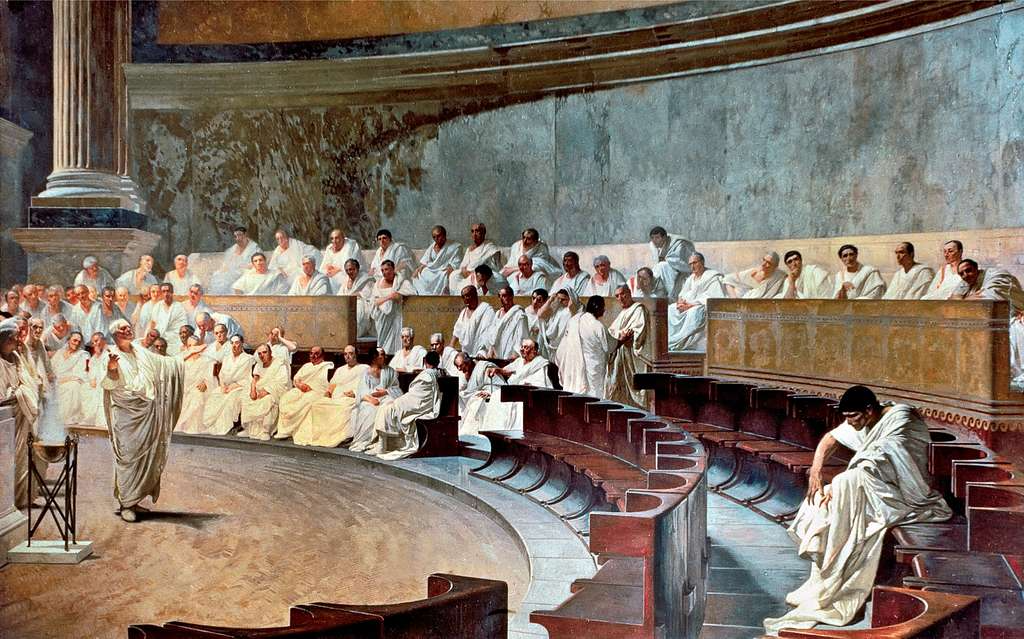
The following post is a slightly edited version of my keynote address at the 2026 Christian Classical League, an annual convention held in western Washington for middle and high school students of Latin, Greek, and/or Hebrew. You can learn more about CCL here.
Thank you for having me. It’s such a joy to be back home—and when I say home, I don’t just mean I’m happy to be back in Washington state, but to be here at the Christian Classical League convention.
Tragically, I graduated high school long before the CCL was founded, but I did spend my formative years attending the JCL, the convention that the CCL was modeled after. When I was growing up, I used to say the JCL was better than Christmas—because it was. I loved JCL. I participated in almost every competition, I did graphic arts even though I had very little natural artistic talent, I memorized Latin prose and poetry for dramatic interpretation, I spent hours and HOURS studying for academic tests and certamen. Basically, JCL was my Super Bowl.
As a result, I’ve always been at home among the Greeks and the Romans. I grew up on the Trojan War myth, Latin literature, Virgil’s Aeneid (in the original Latin, of course), H.A. Guerber’s The Story of the Romans—the stories of the capital C Classics were my fairy tales.
But I also grew up in a world that questioned the value of the classical education I received. From an early age, I was well-trained to answer the question: “Why study Latin?” I had to be, because that was a question I was asked often. But I’m not complaining, because if I grew up in a world that questioned the value of my education, you all have it much worse.
Now more than ever, our culture is so obsessed with efficiency, the product, the bottom line, that the humanities—the study of classics, literature, dead languages, the ancient past—are considered primitive and outdated. For example, I recently came across a social media post written by a young woman boasting that she had discovered a way to read 100 books a week. Obviously, that’s impossible, so I did some digging and found out that she and many others were using an app that uses AI to generate short audio summaries of books. She was listening to those ten-minute summaries and called that “reading the book.”
That’s absurd, of course, but these days, it’s also just the water we swim in. Besides, by modern logic of efficiency and productivity, doesn’t it make a twisted kind of sense? AI has been trained on more books than you could ever hope to read in your life. If ChatGPT has already read Cicero, has read Lucan, has read Virgil and Caesar and Catullus—and it has—then why should you have to? Why shouldn’t technology cut out all the long hard hours of long hard labor so you can get on with your life? Why care about the ancient past?
You might be surprised to learn that Marcus Tullius Cicero, the greatest Roman orator of all time, had to answer that exact question in 62 BC, when his old mentor and rhetoric teacher, Aulus Licinius Archias, was dragged into court by prosecutors who insisted that he was not legally a Roman citizen. Cicero’s speech for the defense—now known as Pro Archia Poeta, “in defense of the poet Archias”—is famous not only as a brilliant example of courtroom rhetoric, but as a deeply moving defense of the humanities.
Cicero begins his defense by saying that whatever skill he has in rhetoric—and keep in mind that Cicero had delivered his famous speeches against Catiline just months earlier, so even at the time, his audience was well aware that he was more or less the best rhetorician alive—he learned all that rhetorical skill in his youth from Archias. He tells the jury that he owes it to Archias to use those same skills to defend him now.
He goes on to make a legal argument that Archias is, in fact, a Roman citizen. But after he finishes his legal argument, he doesn’t sit down. He tells the jury: Even if you still don’t think Archias is legally a Roman citizen, by the time I’m done here, you’ll be so grateful for the important work he does as a poet that you’ll make him a Roman citizen.
Truly, it was the kind of wild move that only Cicero can get away with.
Cicero goes on to make an impassioned defense of the value of literature and the humanities—the very work to which his old schoolmaster had dedicated his life. He says: “If the lessons of literature hadn’t persuaded me from my youth that glory and virtue are the only things worth fighting for, that we should gladly bear every torment, every mortal peril for their sake, I would never have borne so many struggles on your behalf, would never have bared my breast daily to the onslaughts of suffering people. All literature, all philosophy, all history is full of stories of virtue: stories that would all lie hidden in darkness, if the light of literature did not shine on them.”
In other words, the ancient stories taught Cicero what was good, true, and beautiful. They taught him what was valuable, what was worth pursuing. They gave him something to aim for.
C.S. Lewis once wrote that it was not Holy Scripture, but the beauty of “nature [that] gave the word glory a meaning for [him].” He said that he did not know where else he could have found one. Similarly, the stories of the ancient past give meaning to words that might otherwise remain meaningless. They give meaning to the words nobility, and courage, and hope, and virtue—and just as importantly, they give meaning to the words cruelty, and evil, and tyranny.
You might argue that you can find the meaning of these words in any old dictionary, or maybe even from ChatGPT. But the ancient stories don’t just provide clinical and soulless definitions. They give you something else, something an AI plot summary will never give you: experience. If you don’t know the story of how Mucius Scaevola thrust his hand in a fire and stood there like a statue while his skin and muscle melted off the bone, all to prove to an enemy commander that the Romans would never back down, it will mean nothing to you that “the Romans valued courage.” The meaning is in the story.
When I was little and didn’t know what was good for me, I remember asking my mom why I had to study history. Her answer was always the same: “So that you can be an interesting person.” Over time, I have come to understand that this is the only correct answer.
AI gives you bare facts and summaries to be crammed down your throat and forgotten, but the humanities give you the experience of living not only your own life, but the life of the whole world that has come before you. That experience makes the inside of your head an interesting place to live—and for better or for worse, the inside of your head is the only place you will ever live. Living inside your own head can either be an interesting experience or a boring one, and your choices dictate what kind of experience you will have. When you walk out of a movie theater, you can either have interesting thoughts about the movie or no thoughts at all. When you talk to your friends, you can either have interesting conversations, or you can gossip about who said what in your friend group. That’s not an exaggeration. It’s a very real choice that you are still in the process of making. Will your life experience be vibrant and multi-dimensional, or will it be shallow and dull? You get to decide.
Earlier, I posed the following question: Why shouldn’t AI cut out all the long hard hours of long hard labor so you can get on with your life? We might well answer that question with another question: What life are you trying to get on with? In the words of one of my favorite contemporary poets, Joseph Fasano, “What are you trying to be free of? The living? The miraculous task of it?” When you cut out the reading, the thinking, the memorizing, the writing, the labor of ordering and naming and experiencing the world for yourself through your own human eyes, you might discover there is no life left to get on with. As Fasano says far more succinctly, “Love is for the ones who love the work.”
As I draw to a close, I want to leave you with one last thought about Cicero’s Pro Archia Poeta. Let’s not forget that Cicero’s legal client Archias was also his teacher and mentor. Archias taught Cicero about rhetoric, literature, and poetry until Cicero grew up, left his childhood teacher behind, and went on to use that education in incredible ways. But when Archias was in trouble, Cicero dropped everything and came running back to defend him. You, like Cicero, have been given a remarkable gift in your education. I pray that you, like Cicero, will go on to use that education in incredible ways—but none of it matters if you do not also, like Cicero, come running back to defend that tradition when it is threatened.
When the day comes (and it will) when you are called upon to defend Archias, remember the wise words of another group of modern poets, poets I’m sure Cicero would love if he were alive today. I am, of course, referring to the band One Direction, who once sang: “Don’t forget where you belong.”
This heritage is your home. It is your joyful duty to defend it.
